Thursday, July 19, 2012
Pedro Almodovar's Film, The Skin I Live In as Cyberclunk
Pedro Almodovars’s film, The Skin I Live In a great example of what I’ve been describing as contemporary Cyberclunk. Almodovar uses technology as a vehicle to explore ideas that the technology suggests without employing literal futurism or speculations about the literal outcome of that technology as a focus.
Almodovar uses the concept of genetic manipulation as an extension of the films central theme. Robert Ledgard is a scientist and surgeon who specializes in plastic surgery. While running off with her lover, Robert Ledgard’s wife is horribly burned and disfigured in a car accident, but later commits suicide. Here Almodovst explores the idea of how body image affects our sense of self. Despite Ledgard’s every attempt to control his wife’s environment so she won’t become aware of the extent of her disfigurement—eliminating mirrors and covering windows-- she catches of a glimpse of herself and consequently commits suicide. Here Ledgard is first and most devastatingly confronted with the fact that people can’t be changed into what he wants them to be.
After Robert Ledgard’s daughter witnesses the suicide of her mother, she becomes deeply dissociative and is institutionalized in a psychiatric hospital. On her first outing from the hospital, she attends a family wedding, and afterwards is sexually assaulted. The assault has the effect of making her unable to bear human touch, and since her father was the last person she saw after her assault, she has projected the trauma of the assault onto him, associating him with her persecutor.
Ledgard, is now faced with an untenable situation—everyone he loves is lost to him in a way is unable to control---kidnaps her rapist, and slowly, through a series of surgeries, transforms him into the image of his wife. Here transgenesis is used as a metaphor for what Ledgard desperately desires but can never achieve, and the way it’s presented is as much an aesthetic concept as a literal one. Ledgard has set out to give his experiment the perfect skin, impervious to burns,or insect bites—insect bites because it does not give off the odor of human flesh. In a scene that is pure Cyberclunk, Ledgard pieces together his genetically engineered skin like a dress pattern on a manikin. There’s nothing about this that has anything to do with literal science, but it’s a key visual that relates to theme, manipulating flesh like a garment, skin as something worn rather than a part of us.
The work of the artist Louise Borgeouise is also frequently referenced. Here we see Ledgard’s victim identifying with the suggestions of human flesh in Borgeousie’s work, and how she evokes and manipulates our ideas about the human shape. Again and again in the film this theme of the manipulation of the organic is presented. At another point in the film, Ledgard is shown working on a Bonzai tree. Earlier we see someone dressing a shop dummy made of straw, alternately decorating it with artificial birds and bangles.
In the beginning of the film Ledgard mentions that he has participated in some of the first face transplants. He discusses how this transformative experience of having a new face effects the identity and self-image of the patients, and it is this idea of changing someone fundamentally and the emotional core of their being through their appearance that Ledgard believes in so powerfully. He is so heartbroken by his inability to save or change his wife and daughter that he has to believe this. In the end, he’s unable to impose this image he’s created onto the man who has become his victim. He can’t make him into the wife he wanted, or wants him to be. There’s a direct parallel here with transgenesis: what is the consequence of imposing our will onto our genetic code? Is our ignorance of nature the reason why we have decided to impose our will on nature in so specific away?
But the literal aspect of the technology is irrelevant. Whether or not he’s presented the technology in a feasible way is irrelevant. Almodovar’s film is pure cyberclunk in its willful lack of adherence to scientific plausibility, choosing an aesthetic and metaphoric representation of the science over a literal, hard science fiction model. As in all good science fiction, it is not the technology but the ideas presented by the technology that drives the story.
Monday, July 16, 2012
Why Cyberclunk Will Change How You View Science Fiction As a Genre
Science fiction fans are often adamant in their definitions of what science fiction is. There’s “hard” science fiction, or science fiction that is an attempt to literarily portray the possibilities suggested by contemporary technology. There’s space opera-- a romance of the fantastic ideas and imagery generated by science fiction. And then there’s fantasy, or everything else, though sometimes very specifically sword and sorcery or “high fantasy” in the Tolkien mode. And for those tired of these distinctions, there’s the all encompassing, “speculative fiction,” which can describe anything and everything and all of above.
But what if science fiction is simply fiction about science? This doesn’t mean futurism. It doesn’t mean accuracy. Fantasy involving the supernatural is fiction about physics, which is fiction about science. All fiction is speculative fiction, since the very act of imagination is speculation, even if its about what your neighbors might be having for lunch. You can dismiss this as semantics, but words shape how we think about things, so I do think these distinctions can be important in how we view the genre.
Genre is a formal tool. Fiction itself is a formal tool, as is the novel, as is poetry. They are self-imposed limitations on form and structure. Genre, though sometimes about structure, is more a formal constraint regarding content. These formal constraints offer unique challenges. Genre fiction, was, and often is still considered inferior to literary fiction. But in recent years, genre has been embraced by the academic literary community. One way this has happened is through cross pollination, mashing up elements of different genres into something new, or something less obviously recognizable as having precedent. But the work of contemporary authors who have become known for this kind of genre bending, like Chabon and Lethem, shares much in common with science fiction of the past. Authors like Phillip K. Dick who cared little about the consistency of the technology in his stories wrote stories that were arguably not about science at all. Or Ray Bradbury who described a mythic lost alien culture in The Martian Chronicles, presenting lyrical ideas about nostalgia and loss and impermanence that did not have much at all to do with science or any kind of traditional conventions of genre fantasy. But many elements of the genre remained-- the romance of it, the idea of life on other planets and cultures alien to our own. These stories were not deliberate attempts to subvert the genre, genre bending only in the sense that the genre was still being defined. But then, has it ever been truly defined, and does it need to be?
There is no list of rules or definitions that authors adhere to when they write in any given genre. Larry McMurtry subscribes to many of the genre conventions of the Western, but his stories are both Westerns and more than Westerns. But to say that they subvert or transcend the genre is again to suggest that genre is rigidly defined. Stepping out of what are considered the conventions of the genre does not by default make a story more literary than a story that stays within these common conventions. If we are to judge the quality of the content of fiction, distinctions of genre can only serve as a distraction. A story that doesn’t fall within the imagined boundaries of genre can be just as formulaic as as any science fiction story, Western or Romance. Formula is not genre, it’s simply unimaginative or lazy writing, and there’s no genre for bad writing.
I wouldn’t be the first to suggest that science fiction is first and foremost about the time in which it was written, but even in light of this, we often fail to see that futurism is not its purpose. Projections of future technology and outdated attitudes in science fiction of the past seem to us anachronistic and quaint. But all fiction, and all writing for that matter reflects the attitudes of its time. When you read a novel from the past considered now to be literary, there is language and behavior that is no longer contemporary, but we don’t tend to think of this as anachronistic so much as of its time. So why don’t we view science fiction in the same way?
Often the intention of science fiction writers is literal futurism, an attempt to take current social or technological trends and project where they might be headed in the future. This intention, when viewed retrospectively, may seem overly earnest, but non-genre fiction is just as earnest in its own way, just as much an attempt to articulate ideas about human behavior as they were viewed at the time, and in the same way, there is no way to escape those attitudes and conventions in science fiction.
Which Brings Us Back to Cyberclunk
Cyberclunk is not an attempt to subvert genre, but to embrace it. Its formal limitations are no less earnest than in any other genre, and though the suggestion of post-modernism is unavoidable in a post-modern world, post-modern irony is not its focus.
Cyberclunk is not only a genre, but an earnest attempt to view science fiction in a different light. Rather than focus on the idea that the science in the science fiction of the past is anachronistic, Cyberclunk suggests that you accept the world that the author portrays in its totality. Cyberclunk asks you to set aside your literal interpretation of science fiction as futurism and accept the world that the author presents for what it is--not only a reflection of its time but a world in a bubble, a place that the author transports you. As compelling as futurism is as a concept, it can be a distraction if you view it as simple anachronism. Cyberclunk is meant to demonstrate that futurism is not what science fiction is at its center. While Cyberclunk references the technology of its time, it is not a literal projection of how that technology might evolve from contemporary technology. The technology is deliberately implausible in the literal sense. To further emphasize this fact, the consistency in the details of the era are similarly ignored or satirized. Sinatra might exist in the same world as Justin Bieber. Early computing involving magnetic tape might be used in the same environment as the internet.
The goal of Cyberclunk is no less than to change how you view science fiction in general by demonstrating the irrelevancy of the literal scientific relevance of science fiction. The goal of Cyberclunk is no less than to enrich your appreciation of the genre as a whole.
This is cyberclunk. And it’s going to magnificent.
Genre is a formal tool. Fiction itself is a formal tool, as is the novel, as is poetry. They are self-imposed limitations on form and structure. Genre, though sometimes about structure, is more a formal constraint regarding content. These formal constraints offer unique challenges. Genre fiction, was, and often is still considered inferior to literary fiction. But in recent years, genre has been embraced by the academic literary community. One way this has happened is through cross pollination, mashing up elements of different genres into something new, or something less obviously recognizable as having precedent. But the work of contemporary authors who have become known for this kind of genre bending, like Chabon and Lethem, shares much in common with science fiction of the past. Authors like Phillip K. Dick who cared little about the consistency of the technology in his stories wrote stories that were arguably not about science at all. Or Ray Bradbury who described a mythic lost alien culture in The Martian Chronicles, presenting lyrical ideas about nostalgia and loss and impermanence that did not have much at all to do with science or any kind of traditional conventions of genre fantasy. But many elements of the genre remained-- the romance of it, the idea of life on other planets and cultures alien to our own. These stories were not deliberate attempts to subvert the genre, genre bending only in the sense that the genre was still being defined. But then, has it ever been truly defined, and does it need to be?
There is no list of rules or definitions that authors adhere to when they write in any given genre. Larry McMurtry subscribes to many of the genre conventions of the Western, but his stories are both Westerns and more than Westerns. But to say that they subvert or transcend the genre is again to suggest that genre is rigidly defined. Stepping out of what are considered the conventions of the genre does not by default make a story more literary than a story that stays within these common conventions. If we are to judge the quality of the content of fiction, distinctions of genre can only serve as a distraction. A story that doesn’t fall within the imagined boundaries of genre can be just as formulaic as as any science fiction story, Western or Romance. Formula is not genre, it’s simply unimaginative or lazy writing, and there’s no genre for bad writing.
I wouldn’t be the first to suggest that science fiction is first and foremost about the time in which it was written, but even in light of this, we often fail to see that futurism is not its purpose. Projections of future technology and outdated attitudes in science fiction of the past seem to us anachronistic and quaint. But all fiction, and all writing for that matter reflects the attitudes of its time. When you read a novel from the past considered now to be literary, there is language and behavior that is no longer contemporary, but we don’t tend to think of this as anachronistic so much as of its time. So why don’t we view science fiction in the same way?
Often the intention of science fiction writers is literal futurism, an attempt to take current social or technological trends and project where they might be headed in the future. This intention, when viewed retrospectively, may seem overly earnest, but non-genre fiction is just as earnest in its own way, just as much an attempt to articulate ideas about human behavior as they were viewed at the time, and in the same way, there is no way to escape those attitudes and conventions in science fiction.
Which Brings Us Back to Cyberclunk
Cyberclunk is not an attempt to subvert genre, but to embrace it. Its formal limitations are no less earnest than in any other genre, and though the suggestion of post-modernism is unavoidable in a post-modern world, post-modern irony is not its focus.
Cyberclunk is not only a genre, but an earnest attempt to view science fiction in a different light. Rather than focus on the idea that the science in the science fiction of the past is anachronistic, Cyberclunk suggests that you accept the world that the author portrays in its totality. Cyberclunk asks you to set aside your literal interpretation of science fiction as futurism and accept the world that the author presents for what it is--not only a reflection of its time but a world in a bubble, a place that the author transports you. As compelling as futurism is as a concept, it can be a distraction if you view it as simple anachronism. Cyberclunk is meant to demonstrate that futurism is not what science fiction is at its center. While Cyberclunk references the technology of its time, it is not a literal projection of how that technology might evolve from contemporary technology. The technology is deliberately implausible in the literal sense. To further emphasize this fact, the consistency in the details of the era are similarly ignored or satirized. Sinatra might exist in the same world as Justin Bieber. Early computing involving magnetic tape might be used in the same environment as the internet.
The goal of Cyberclunk is no less than to change how you view science fiction in general by demonstrating the irrelevancy of the literal scientific relevance of science fiction. The goal of Cyberclunk is no less than to enrich your appreciation of the genre as a whole.
This is cyberclunk. And it’s going to magnificent.
Wednesday, July 4, 2012
Translation Software an Aid and Impediment to Understanding Other Cultures, or How Translatey is Translation Software really?
I recently had a short dialog with a man from Brazil using a translation site called "Babylon." I've used translation software before, but never to have a dialog with an actual person. It was an enlightening experience, and one that posed a number of questions. In my last correspondence, I discussed what I thought about the software and it's future repercussions. Here's a piece of that dialog:
This is the first time I've attempted a dialog using this kind of software. I think translation software has improved considerably since I last attempted to use it. In the beginning the results were often comical. I do think that the translation software of the future is going to have to be a lot smarter, not only, as you mention, because of colloquialisms, but phrasing, conventions of speech, grammar, and culture.
Portuguese, as a latin based language probably translates a lot better than Japanese, for instance. I think translation software is not only going to have to translate but interpret, and interpretation is an a little bit of an art. Computer-based translators are going to have to have some form of artificial intelligence behind them to do their jobs more effectively. Maybe they'll use search technology to compare and choose what's going to be the most frequently used and appropriate phrasing. Somehow it's going to have to be more of an open system, and each translation app is going to have its own distinct voice.
Still, no translation is perfect, and the risk is that we all become just a little more lazy about understanding other cultures. If we can put our own cultural "skin," so to speak, on another person's language or culture through either online translation or some kind of real time, on location, augmented reality technology (Google Glasses), we're not only translating but imposing our culture onto the culture of someone else. Words and their use have specific cultural meaning in a cultural context. We don't want to lose that. Understanding enough to communicate on a basic level is not the same as full comprehension, but it can give the illusion that you understand more than you do. Translation of any kind is a expedient, not a solution, an is often as much an impediment to understanding as it is a aid.
But this is still all in the future, when tourists will visit other countries and have real time translations of their discussions and everyone will be able to make their basic needs understood when traveling abroad. Since there's no way (or method in the perceivable future) to fully understand every language we encounter, translation software will aways be a half measure. Still, it's a remarkable gift to be able to have this discussion. It's a pleasure to make your acquaintance!
I have no idea how accurate the translation is (I'm pretty sure the punctuation is just a little off, among other things), but if it's anywhere near as accurate as what I've been getting from him, we've been able to make one another understood amazingly well. This software has a lot of potential, but I also fear that translation software and augmented reality technology, may only increase the gap between genuinely understanding another culture. As I described earlier, augmented reality as presented by Google provides a "skin" of information over everything we see, and that skin gives the illusion of understanding. Add translation to this technology and the illusion is even greater. Without it, the gap between this illusion of understanding and the reality is more apparent. With the advancements of translation software, it may be hard to allow ourselves to discard this illusion and learn about other cultures in a genuine way. To understand another culture on a deeper level, we first have to concede to the fact that we have no idea of the true context of the translation.
Tuesday, June 19, 2012
The Philosophy of Cyberclunk, Or Why Science Fiction Can't Escape Becoming Embarrassingly Dated
Ever since I started reading sci-fi as a kid, I had this habit of trying to apologize in my head for the author's annoying lack of prescience. Maybe they hadn't gotten it quite as wrong as it seemed like they had. Maybe Asimov didn't mean that information was stored on microfilm, as in actual microfilm in the Foundation series instead of computers. Maybe the kids in Heinlein's Red Planet talked in that "gee whiz fellers"1950s dialogue for some other reason than the fact that the book was written in the 50s. I was a literal minded kid, but, like most sci-fi, these were literal minded books, and I desperately wanted them to be relevant. Not that all the ideas in these books had dated so poorly, but they were unavoidably out-of-step with the times.
Science fiction more than ever, because of the rapid progress of technology, dates as fast as it can be written, and much faster than it can be published. Moore's law--the suggestion that the number of transistors that can be placed on an integrated circuit will double every two years--assumes that the integrated circuit will continue to be what drives computing in the future. Maybe in another couple of decades, computers will cease to be digital at all. Maybe they won't even be called computers anymore. There's no exponent that can describe the growth of technology that doesn't exist yet.
Aside from his inability to predict what none of us could predict--in Asimov's time, there was no World Wide Web or cloud computing and microfilm still sounded high tech--Asimov was not exactly known for the quality of his prose, and slogging through his awful dialog could be a painful experience, so his work unfortunately dates for reasons beyond his less than accurate projections of future technology. Like most American writers--not only science fiction writers--Mr. Asimov was painfully literal. He saw science fiction as futurism, as a literal conception of where technology might be headed. In the argot of the genre, this is "hard science fiction," hard, apparently, because of the bluntness required to base a literal future you can't know on 1950s rocket science and magnetic tape. So in ten, twenty years or more, what remains relevant, ironically, is everything in the story that isn't about technology. Sure, Arthur C. Clarke was savvy enough to come up with the idea for satellites. A.E. Van Vogt sort of predicted computers, what he called, "electronic brains" since the word "computer"wasn't yet in popular use. William Gibson predicted virtual reality, or at least, a romantic version of the idea. Neal Stephenson, virtual communities. But as fascinating as these predictions are, this isn't why we still read these books.
So what science fiction has held up better over the test of time? Frank Herbert's Dune seems to have held up well, more philosophical romance than futurism. The lyrical writing of Samuel Delaney and Ray Bradbury, in part, for the rich quality of the writing, even if the prose can occasionally be a little purple. Ursula K. LeGuin, another solid writer has held up well, particularly for The Left Hand of Darkness and The Dispossessed about imagined communities based on social, rather than technological projections. Stanislaw Lem's Futurological Congress both predicts and affectively satirizes virtual reality before it was even a term, and even translated from Polish, is still laugh out loud funny. Orwell's 1984 hardly dates at all. In its first paragraph its clear that it's not at all clear to the narrator that this is the true year, a fact that I was very pleased with as a kid when I read it in1984. Phillip K. Dick's popularity has actually increased over the years, and he is more widely read than all of the above, with the possible exception of Dune.
But ultimately science fiction has to be a reflection of its time. Sexism, colonialism and the primacy of Western culture as defined by a white male society is the unfortunate stuff of science fiction from both our immediate past and present. When I recently reread Heinlein's Stranger in A Strange Land as an adult, I was particularly dismayed by the Hugh Hefnerish Jubal Harshaw, a wealthy writer surrounded by adoring lady friends, an embarrassingly transparent fantasy persona of the author himself. The sexism is on the scale of TV's Mad Men, but unlike Mad Men, is completely lacking in self-awareness. It even dips into some pretty damning homophobia in the second half despite all its free-love, 60s sexual revolution inspired progressiveness. I missed most of this as a kid in the 80s, but as an adult I barely made it to the end.
It's particularly galling what limited imaginations science fiction writer's still seem to have when it comes to alien races. They frequently resort to racial and cultural stereotypes that embody every cliche there is about noble savages, inscrutable Asians and Jewish Shylocks, as if the only way we can conceive of an alien culture is to return to our colonialist roots. The caricatures are even broader in film and television. The racial stereotypes in Lucas' recent Star Wars films is a subject that deserves its own essay. Not too long ago, the African American actor Michael Dorn was cast as Star Trek the Next Generation's own noble savage, the Klingon, Worf, without any apparent irony. Brown is still the color of aboriginal savagery too often in science fiction and high fantasy both. In the fantasy of the past, it's been C.S. Lewis' swarthy and transparently Arab inspired Calormenes, and more recently, George R.R. Martin's Targaryen.
In film, extraterrestrials now seem to be primarily insect-like, usually hostile and with no greater motive than world domination. The image of insects in our culture is inherently alien and malevolent, so it's an easy go-to. District 9 made a well-intentioned attempt to subvert this image, but despite its intentions, the South African film couldn't seem to avoid a colonialist and patronizing view of its aliens. An obvious metaphor for the countries own race problem, the insect-based alien immigrants, despite their supposed superior technology, were too naive to make any social or diplomatic headway with the humans. The were relegated to shanty towns, and traded their superior weapons for cat food.
In recent years science fiction has looked to the past for its aesthetics, if not, thankfully, it's social perspectives with Steampunk. While William Gibson and Bruce Sterling's original Steampunk novel The Difference Engine was all about technology, an exploration of an alternate future where Charles Babbage's precursor to the contemporary computer was successful, contemporary Steampunk leans more towards the aesthetics of the Steampunk environment, sharing more in common with the romance of The Lord of the Rings and Star Wars than with Gibson and Sterling's doctrinaire adherence to "Hard Science Fiction." But at the same time, Gibson and Sterling too are romanticists, their prose invested with an unbridled love of technology, Gibson frequently using technological metaphors in his more poetic passages. Considering this approach, there's no wonder that the Difference Engine inspired a genre of romance over hard science.
China Mieville has solved the problem in his own way, making no attempt to adhere to traditional sci-fi or fantasy tropes. His books are not quite hard science fiction, space opera or high fantasy, but something else altogether. He freely mixes supernatural elements with technology, inhabiting his worlds with what would in science fiction be alien races, but in Mieville's fiction are indigenous with humans. Unfortunately Mieville's "New Weird" can occasionally fall into some of the same traps of prejudice so common in the genres he subverts, but it's a rich world that is truly unlike any other in genre fiction.
Another favorite of mine, Haruki Murakami's Hardboiled Wonderland and The End of the World defies categorization, a little bit magical realism and a little bit science fiction and a little bit something else, and of course, it has the best title ever.
The Philosophy of Cyberclunk

Like most movements, Cyberpunk didn't originate with the two men attributed with its invention, William Gibson and Bruce Sterling, any more than the origins of Cubism came from Picasso and Braque. The seeds were already in the air. Writers like Phillip K. Dick and Stanislaw Lem frequently dealt with questions of reality, biology and technology, and Phillip K. Dick is often seen as the grandfather of the movement. But rather than American sci-fi pulp and book covers where most sci-fi imagery had come before, the imagery of Cyberpunk came from France in the form of bande dessinee, or comic books. The magazine Metal Hurlant (in the states, Heavy Metal), through artists like Moebius, Bilal and Druillet, inspired the visuals that would eventually accompany the ideas of cyberpunk, and Gibson describes the magazine as a seminal influence. And from the inspiration of Phillip K. Dick, Metal Hurlant and the designs of Syd Mead came Bladerunner, the visual template for everything cyberpunk to come, before cyberpunk even had a name. But this thirty year old aesthetic is one that sci-fi still can't seem to escape. The inspiration for most contemporary sci-fi imagery either comes from Bladerunner or Star Wars, which also, not coincidentally, features a number of designs by Mead.
So where does the term originate? "Cyber" comes from cybernetics, which describes the relationship between mechanics and biology, but why "punk?" The term "Cyberpunk" was coined in the 80s, when punk culture was flourishing as a progressive cultural movement, and even now, punk continues to be associated with youth culture. So the appropriation of the word, "punk" was a deliberate attempt to give the Cyberpunk movement a sexiness and sense of relevance that sci-fi never had before. The present version of punk is less a genuine social movement than a convention of fashion, but the word "punk" and the culture associated with it continues to sustain it's hipster allure. Like punk, Cyberpunk, too, has lost some of its original progressiveness, almost as much pure aesthetic at this point as its Steampunk counterpart. Now any version of the future that portrays youth culture and virtual reality is by default considered Cyberpunk. As much as high fantasy or any other genre, the genre of Cyberpunk is firmly in place and there's no escaping it.
the "cyber of "Cyberclunk," in keeping with this derivation of the word "cybernetic," describes a similar exploration of technology and biology, while it's suffix, "clunk" is both a parody of it's progenitor, and an unapologetic embrace of science fiction's irredeemably clunky, dated, awkward and utterly unhip origins. It's a rejection of both the fashion of Cyberpunk, and the deadpan, humorless tone of most science fiction. Neal Stephenson added much needed satire to Gibson and Sterling's Cyberpunk with Snow Crash, but still couldn't avoid treating science fiction as futurism. Cyberclunk has suggestions of futurism, while at the same time, is a deliberate attempt to subvert it.

Like most movements, Cyberpunk didn't originate with the two men attributed with its invention, William Gibson and Bruce Sterling, any more than the origins of Cubism came from Picasso and Braque. The seeds were already in the air. Writers like Phillip K. Dick and Stanislaw Lem frequently dealt with questions of reality, biology and technology, and Phillip K. Dick is often seen as the grandfather of the movement. But rather than American sci-fi pulp and book covers where most sci-fi imagery had come before, the imagery of Cyberpunk came from France in the form of bande dessinee, or comic books. The magazine Metal Hurlant (in the states, Heavy Metal), through artists like Moebius, Bilal and Druillet, inspired the visuals that would eventually accompany the ideas of cyberpunk, and Gibson describes the magazine as a seminal influence. And from the inspiration of Phillip K. Dick, Metal Hurlant and the designs of Syd Mead came Bladerunner, the visual template for everything cyberpunk to come, before cyberpunk even had a name. But this thirty year old aesthetic is one that sci-fi still can't seem to escape. The inspiration for most contemporary sci-fi imagery either comes from Bladerunner or Star Wars, which also, not coincidentally, features a number of designs by Mead.
So where does the term originate? "Cyber" comes from cybernetics, which describes the relationship between mechanics and biology, but why "punk?" The term "Cyberpunk" was coined in the 80s, when punk culture was flourishing as a progressive cultural movement, and even now, punk continues to be associated with youth culture. So the appropriation of the word, "punk" was a deliberate attempt to give the Cyberpunk movement a sexiness and sense of relevance that sci-fi never had before. The present version of punk is less a genuine social movement than a convention of fashion, but the word "punk" and the culture associated with it continues to sustain it's hipster allure. Like punk, Cyberpunk, too, has lost some of its original progressiveness, almost as much pure aesthetic at this point as its Steampunk counterpart. Now any version of the future that portrays youth culture and virtual reality is by default considered Cyberpunk. As much as high fantasy or any other genre, the genre of Cyberpunk is firmly in place and there's no escaping it.
the "cyber of "Cyberclunk," in keeping with this derivation of the word "cybernetic," describes a similar exploration of technology and biology, while it's suffix, "clunk" is both a parody of it's progenitor, and an unapologetic embrace of science fiction's irredeemably clunky, dated, awkward and utterly unhip origins. It's a rejection of both the fashion of Cyberpunk, and the deadpan, humorless tone of most science fiction. Neal Stephenson added much needed satire to Gibson and Sterling's Cyberpunk with Snow Crash, but still couldn't avoid treating science fiction as futurism. Cyberclunk has suggestions of futurism, while at the same time, is a deliberate attempt to subvert it.
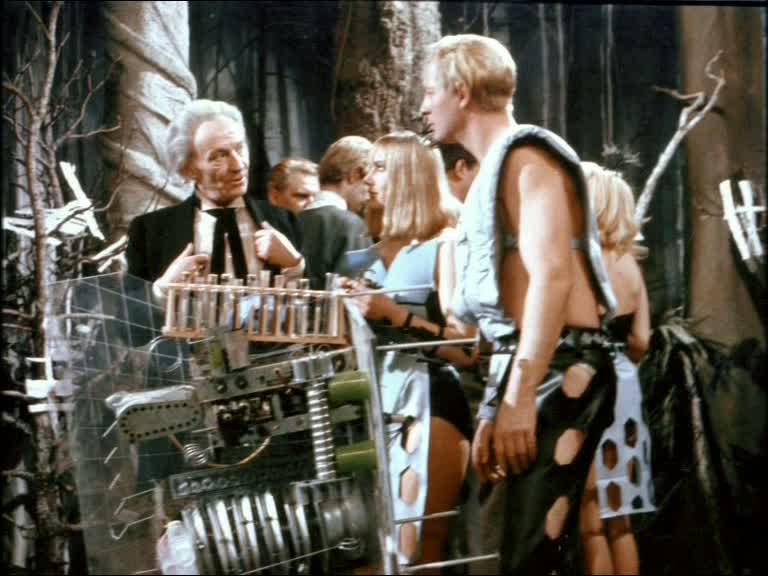
Cyberclunk as pure aesthetic borrows from early science fiction films and TV shows, cyberclunky more by necessity than intention. In an attempt to portray the future on a limited budget, the technology of the day was cannibalized to stand-in for high tech gadgetry, with the earnest hope that no one would notice the difference. The original Doctor Who is one of my favorite examples of this unintended aesthetic, where so often the origin of the repurposed gadget, whether a bathroom plunger or egg beater, is gloriously apparent. Spaceship interiors made of aluminum siding. Anything involving tinfoil--this was what made Doctor Who twice as fun. The original Star Wars is also all about cyberclunk, and attempts to avoid any comparison to contemporary technology with it's bold statement, "A long time ago in a galaxy far, far away."
![]() |
| Doctor Who: gloriously Cyberclunk |
![]() |
| Plunged to death by a Dalek! |
![]() |
| A long time ago, in a galaxy far, far away...there was Cyberclunk! |
Like Steampunk, the Cyberclunk movement that I've just made up embraces the aesthetic of its environment, old technology repurposed to give shape to new. Cyberclunk attempts to eliminate the pretense that the story is anything but an extrapolation of the events of the time in which it was written. Like most things American, it's a completely literal concept. It's not magical realism, or Mieville's version of fantasy, but a romance and satire of technology as we know it today. References to contemporary popular culture are not made with an assumption that they will still be popular in the future, because the story isn't explicitly about the future. While there are projections of future events based on current ones much like the old stories about rocket science and magnetic tape, there's no assumption at all that this is how the future is going to be. It is unapologetically, undeniably about right now, which means that, inevitably, it will become dated just as quickly as all science fiction does, but integral to its concept is an acknowledgement of this fact.
The zeitgeist of cyberclunk is already in the air. All I've done is given a name to to it. and if it doesn't exist already, then it does now because I say it does. Isn't that how all these things start?
Labels:
Bruce Sterling,
China Mieville,
Cyberclunk,
Cyberpunk,
Doctor Who,
Isaac Asimov,
Neal Stephenson,
Robert Heinlein,
Science Fiction,
Star Trek,
Star Wars,
Steampunk,
Ursula LeGuin,
William Gibson,
Worf
Wednesday, June 13, 2012
We Love the Miami Zombie!
![]() |
| Oh come on. Click on me. You know you want to look. |
It was too good to be true.
A zombie attacks a homeless man and chews off half
his face. OK, maybe he wasn’t a zombie, but he was about as close as you could
ever hope to get. He was growling. He was naked. He was eating off someone’s
face. Had he eaten off anybody else’s face? Maybe he wasn’t a zombie, but at
least he was a cannibal. Maybe he was a serial killer cannibal?
OK, so it turned out that this was the only face he
had eaten, but oh how he had eaten. He had eaten a nose, an eyeball and no less
than half a face in a feeding frenzy that did not end until he was shot by a
cop. That’s some seriously fucked up zombie shit right there.
But do zombies have to be the walking dead to be
zombies? Why no they don’t in fact. But
what are the criteria? As we’ve learned from films like 28 Days Later it can be
a virus. In The Crazies it’s some kind of disease, and that one was by George
Romero, the man himself! So if it can be a disease or a virus, then why not Bath Salts and cocaine?
Wha-wha-wha-wha whoah-- what in the fuck are
“Bath Salts?”
Bath Salts or
Methylenedioxypyrovalerone,also known as Cloud 9, MDPK, MTV, Magic,
Maddie, Black Rob, Super Coke, PV and Peeve, or as we like to call it, The
Zombie Designer Drug, synthesized in 1969, made popular in the early 2000s, and
banned for the first time in the US no earlier than 2011. It causes panic
attacks, hypertension, hallucinations, suicidal thoughts and extreme anxiety
sometimes progressing to violent behavior-- or so says Wikipedia. But how often
is “sometimes?” So maybe it turns out it’s more likely to give you panic
attacks and hypertension than to cause you to eat someone’s face off. These,
unfortunately, are not the predictable results we’re looking for here.
Godammit.
OK, so it turns out the
guy who got attacked was this homeless guy with the adorable name of Ronald
Poppo. “Ronald Poppo lives in the moment” said the reporter.
"It's Amazing. He's an extremely charming man," said his doctor.
After surgery, Poppo, a
Miami Heat fan, said, “Go Heat.”
He said, “go Heat,”
quoth the reporter, before she tells us that maybe there’s a bright side to
this story after all. He’s in good spirits. He’s got his own bed. He’s eating
his favorite foods, oranges and pizza. Weighing the options, she came to the
right conclusion that having your face chewed off is slightly better than being
homeless.
So, as long as you’re
homeless and have the right attitude, getting your face eaten off by a zombie
can turn out to be a pretty sweet deal. Be charming. Say “go Heat.” To further
endear yourself to the public, request your favorite foods, oranges and pizza.
Everyone loves oranges and pizza. Have a cute name like “Poppie.” A special
fund will be set up in your honor, and you will get donations from all over the
world from people who are glad to give to the charming, endearing homeless man
who entertained us so much by having his face eaten off by a zombie, while
having the decency to stay in good spirits and thus, not make us feel like
dicks for how cool we thought it was when we first heard about it. And maybe
after you get what’s left of your face patched together and have paid all your
medical bills, there will be some spillover from that fund for you to afford to
rent an apartment—at least for a while-- and get some dental care for your few
remaining teeth. And until that day when you are sent on your way from the
hospital with one eye, no nose, and season tickets for the Miami Heat, the
world will love you. And then they will forget about you. At least until you’re
mentioned as a footnote in the next cannibal zombie attack.
The story of the Miami
Zombie is a story of hope. The hope that there could someday be a zombie
apocalypse or a face devouring cannibal serial killer, or maybe a designer drug
that turns those douches who go to raves into undead hoards for us to kill.
The Miami Zombie is
dead! Long live the Miami Zombie!
Subscribe to:
Posts (Atom)